Resources
Consumer Price Index
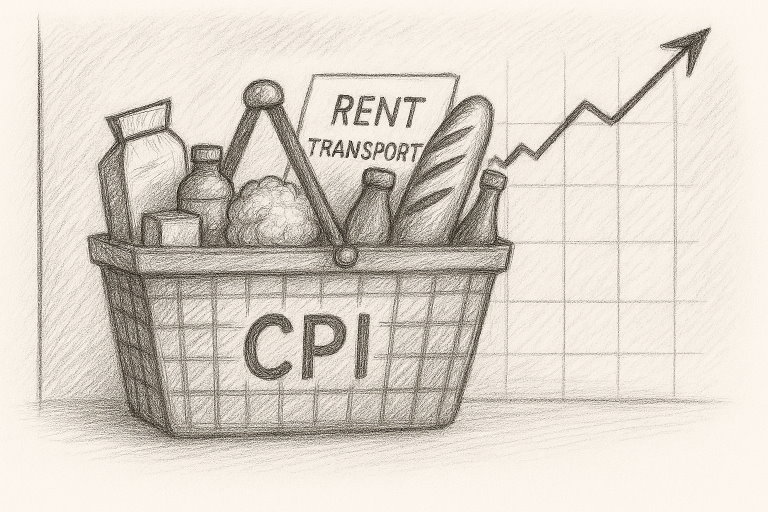
The Consumer Price Index (CPI) is a way of checking how much the cost of everyday things changes over time in Australia. Imagine a shopping basket filled with common items like food, clothes, rent, and transport. If the total cost of that basket goes up, it means prices are rising (inflation). If it goes down, prices are falling. The CPI helps the government, businesses, and the Reserve Bank decide things like interest rates and wages. It’s basically a tool to see how the cost of living is changing.
When your wages don’t go up as much as the CPI, it means you can't keep up with the rising cost of things you need to buy. Prices for food, rent, and other essentials increase, but if your income stays the same or only rises a little, you can’t buy as much as before. This makes it harder for families to afford the same lifestyle, and people might have to cut back on things they enjoy or even struggle with basics. In short, if your wages don’t match price increases, your money won’t stretch as far.
Data Notes and Methodology
- Sometimes Councils link future wage increases to CPI in their Certified Agreements. Brisbane CPI quarterly figures are generally used in these cases.
- The CPI baseline is set using the CPI quarter that is closest to the corresponding Council wage increase.
- Prior to October 2025, CPI data was updated quarterly, but is now updated monthly. As all Certified Agreements currently reference the quarterly CPI, it will continue to be used going forward.
- The CPI data can be found on the Australian Bureau of Statistics (ABS) website: Consumer Price Index - Australia
- Quarterly CPI figures on this website come from the file: TABLE 17. CPI: Quarterly All Groups, Index numbers and Percentage change [641017.xlsx].
- In the Data1 tab, Column A (Series ID) and Column M (Percentage Change from Previous Period; All groups CPI; Brisbane; [A2325820F]) are used.
- For checking CPI wage increases in Certified Agreements, the file: TABLE 1. CPI: All Groups, Index numbers and Percentage change [64101.xlsx] is used.
- In the Data1 tab, Column A (Series ID) and Column N (Percentage Change from Corresponding Month of Previous Year; All groups CPI; Brisbane; [A130397383X]) are used.
Wage Price Index
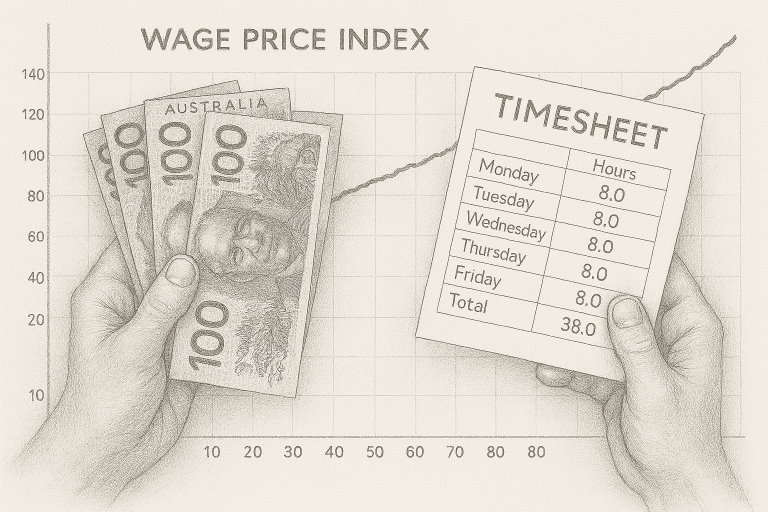
The Wage Price Index (WPI) measures changes in the price of wages and salaries in the Australian labour market over time. In a similar way to the CPI, it follows changes in the hourly rate paid to a fixed group (or “basket”) of jobs. The Fair Work Commission uses the WPI as a key source of data and evidence when setting national minimum and award wages and other business use the WPI as part of their decision making when considering wage increases.
Data Notes and Methodology
- The WPI baseline is set using the WPI quarter that is closest to the corresponding Council wage increase.
- The WPI data can be found on the Australian Bureau of Statistics (ABS) website: Wage Price Index - Australia
- WPI figures on this website come from the file: Table 1. Total hourly rates of pay excluding bonuses: sector, original, seasonally adjusted and trend [634501.xlsx].
- In the Data1 tab, Column A (Series ID) and Column L (Percentage Change From Previous Quarter; Total hourly rates of pay excluding bonuses; Australia; Public; All industries; [A2603990F]) are used.
Certified Agreements

In Australia, Certified Agreements (CAs), Enterprise Agreements (EAs) and Enterprise Bargaining Agreements (EBAs) are all types of legally binding employment contracts that outline the terms and conditions of employment for a specific group of employees. The key difference lies in their origin and process: EAs and EBAs are negotiated at the enterprise level (between an employer and employees) while CAs are a specific type of industrial instrument covering conditions of employment for a particular employer.
Certified agreements for Queensland Councils are typically structured as council-specific documents that sit above the state-wide Queensland Local Government Industry Awards. They are often divided into different "streams" to address the specific working conditions of various staff groups, such as Stream A for administrative and professional officers and Streams B and C for operational and trade employees. These agreements outline essential employment terms including annual wage increases, overtime rates, and leave entitlements, and must be formally ratified by the Queensland Industrial Relations Commission (QIRC).
Data Notes and Methodology
- The Certified Agreements for all Queensland Councils can be found on the website of the Industrial Court of Queensland - Queensland Industrial Relations Commission: Local Government Agreements
- See each specific Council page for notes on the data, processing and methodology used for that Council.
Frequently Asked Questions
Can I share content from this website to other people? Can I adapt content for an article, report, newsletter or project?
Yes, content from this site is available under a Creative Commons Attribution 4.0 International license. You can share or adapt the content as long as you provide appropriate credit - see the license for more information.
Suggested attribution statement: Content from comparecouncilwages.com.au, licensed under CC BY 4.0
Who are you and why have you created this site?
We are a group of Local Government employees in South-East Queensland. We are not members of, or affiliated with, any union. Our aim is to provide independent and factual information on wages and terms and conditions to other Local Government employees to enable better outcomes in Certified Agreement negotiations.
I work at Council X, where is our data?
It takes quite a while to compile, process, check and publish data for each Council. We have to start somewhere, so are currently working on Stream A agreements for the largest Councils in the SE Qld area.
I think this site is great, how can I help?
- Tell your work colleagues and supervisors about us. Even tell your friends and family. Post about it on social media. Every visit helps spread our information out to those who need it.
- Councils that are currently in the enterprise bargaining process are of great interest to us. We can publish extra information using proposed wage increases so that Council employees can compare future wages and be fully informed. You can send us a message with this information via our Contact page.
How do I know the information you are providing is true?
We provide links to the source data we have used and extensive notes on our methodology and processing. If you believe we have made an error or something is not clear, then please Contact us.
How can I ask a question, or provide information or feedback?
Please use the form on the Contact page to send us a message. You can remain anonymous if you wish.